

Why Clarity in Visual Messaging Matters More Than Creativity Alone

Every person who has been in the print or direct mail business long enough has observed this occur.
A company takes weeks to create the flyer. The colors are bold. The layout is modern. Its design impresses on a screen. It is attractive to everyone.
Then it is printed, mailed, or distributed, and nothing is done.No calls. No foot traffic. No measurable lift.
In the meantime, a more basic competitor flyer, fewer colours, white space, and a directive headline silently win it.
This discrepancy between what appears good and what is effective is one of the most intractable problems in printed marketing. In the middle of that is the truth that print professionals are familiar with and which they fail to say:
In print, clarity is better than creativity, as it hinders comprehension.
The Real Way People Interact With Flyers

With flyers, hardly anybody consumes them as the designers would wish.
They’re not studied. They’re scanned.
Most flyers are encountered.
- As she sorted mail above a garbage window.
- As one passes a counter or a door.
- While standing in line
- Turning the pages of a stack of papers.
A study commissioned by the Data and Marketing Association found that the average response time to physical mail on the first instance is 3-5 seconds, after which a keep-or-discard decision is made. Flyers do not fail because people hate print; they fail because they do not surface quickly enough with the message.
That is why even beautiful flyer designs may not perform. In case the headline is not immediately obvious or the deal is not obvious at a glance, the article is not read again.
Creativity Often Fails at the Exact Moment It’s Supposed to Help
The following is an example of an everyday situation that a local business flyer encounters with local printers:
A cleaning company would like to be unique, and thus the flyer employs:
- Multiple background image
- Decorative fonts
- Soft color contrasts
- Clever but vague headlines
The result? The flyer is well refined; however, service, price range, and action steps are not clear.
Compared to a rival cleaning business flyer with:
One powerful headline (Weekly Home Cleaning -First Visit 20% Off).
- High-contrast text
- One phone number or QR code
- No visual distractions
The second flyer will be less creative but easier to digest, which also translates into a direct response.
The same trend is observed in terms of categories:
- Automotive business flyers
- Laundry business flyers
- Lawn business flyers
- Flyers of the Bakery and food business.
Visual novelty is unnecessary when people are already familiar with the services. They require assurance and understanding.
Why “Attractive” Is a Dangerous Design Goal
The phrase "attractive flyers" is used constantly in print marketing—and it’s part of the problem.
Attractive to whom?
- Designers?
- Business owners?
- Other marketers?
The end reader doesn’t care if a flyer feels creative. They care if it feels relevant and trustworthy.
Studies in visual cognition show that high visual complexity increases cognitive load, slowing comprehension and reducing recall. In print, slowing comprehension is deadly.
That’s why effective business flyers tend to share unglamorous traits :
- Short, direct headlines
- Simple layouts
- Predictable structure
- Obvious calls to action
They don’t win design awards; they win customers.
High-Performance Flyers Are Built Backwards
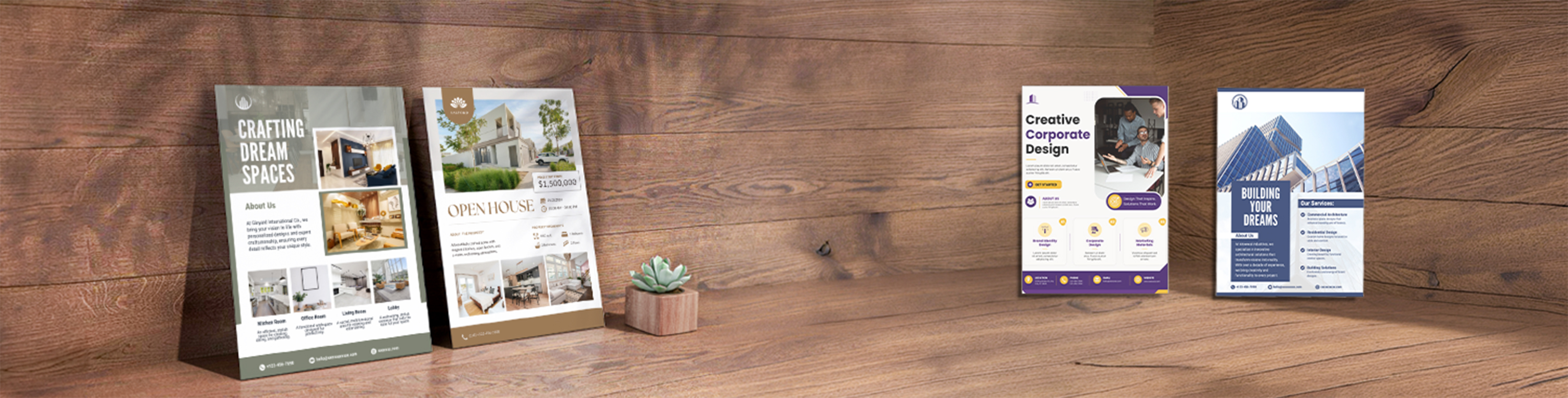
One of the most reliable ways to create high-performance flyers is to design backwards from action.
Instead of asking : “How do we make this more creative?”
The better question is : “What do we want someone to do in 5 seconds?”
When that answer is clear, everything else falls into place :
- The headline exists to support that action
- The layout exists to guide the eye
- The imagery exists to reinforce trust
This is especially important for :
- Business flyers for grand openings
- Promotional inserts
- Door-to-door local campaigns
In these cases, flyers are not brand statements; they are decision prompts.
Where Print Quality Supports (or Breaks) Clarity
Where Clarity is Supported (or Broken) by Print Quality.
A brilliant design may not work when a printing decision does not favor it.
This is a frequent case with print professionals:
- Light ink on glossy paper lowers the readability.
- Low-contrast designs become unintelligible in print.
- Physical layouts are increasingly becoming difficult to scan, especially when overcrowded.
This is why the process of printing business flyers is not merely a part of production; it is part of the communication process.
The quickness of information absorption is influenced by paper stock, finish, and color accuracy. The high level of trust created by clean design and consistent print quality positively influences response rates.
It is also why most print providers lead customers away from overdesign, not to restrict creativity but to maintain performance levels.
Creativity Still Matters, Just Not Where Most People Use It
This isn’t an argument against creativity. It’s an argument for placing creativity where it helps, not where it hurts.
Creativity works best in flyers when it :
- Highlights the offer
- Improves hierarchy
- Reinforces brand recognition
- Makes the message easier to remember
Creativity fails when it :
- Obscures the main point
- Competes with the call to action
- Forces the reader to “figure it out.”
The best professional business flyers feel simple, but that simplicity is deliberate.
Why Clarity Is a Competitive Advantage in Print
In a world overloaded with visual noise, clarity feels rare.
For direct mail marketers and printers, this creates an opportunity. Businesses don’t need more visual complexity. They need communication that respects how people actually behave.
Clear flyers :
- Reduce friction
- Improve response predictability
- Lower redesign cycles
- Scale better across campaigns
That’s why clarity isn’t just a design preference — it’s a performance strategy.
Companies like EzSignStore, which work closely with businesses on custom signs and printed materials, see this daily: the flyers that perform best aren’t the most creative ones—they’re the ones that make the most sense.
Final Thought
Creativity without clarity is decoration. Clarity without creativity is functional.
Together, they’re powerful, but only when clarity leads.
In print and direct mail, attention is borrowed, not given. Flyers don’t earn time by being clever. They earn it by being clear. And in the end, the flyer that gets remembered isn’t the one that looked the most creative—it’s the one that made the decision easy.
Custom Signage Specialist | EzSignStore
New York City Metropolitan Area
Founder of EzSignStore, a print and signage company helping businesses, real estate professionals, and community organizations bring their ideas to life.
Passionate about creative, high-impact signage, including banners, yard signs, stickers, and custom graphics.